Die EU-Kommission hat in ihrem 2026 Country Report – Germany (3.6.2026 – SWD(2026) 205 final) dem Land den Spiegel vorgehalten. Eine klare Mahnung, auf Zukunft zu schalten und sich zu lösen von den „wir müssen zurück zu“-Nörglern.
Research and innovation are key to unlocking new growth opportunities. … Boosting business dynamism is crucial for competitiveness, as the old economic structure increasingly faces challenges.
Nicht tragfähige Untermnehmen haben keine Zukunft, die Ressourcen müssen umverteilt werden zu produktiven und innovativen Firmen. So der Report.
Germany’s reliance on mid-tech industries and a weaker innovation output rate suggest lock-in effects and difficulties in adapting to emerging technologies.
Hierbei stehen strukturelle Schwächen in Frage. Da ist etwa die Investitionsseite:
Germany’s economic and financial landscape is characterised by conservative and low-risk investment behaviour across firms, households and institutional investors. This has supported stability, but limited growth.
Es betrifft qualifiziertes Personal:
The shortage of skilled workers affects Germany’s innovation capacity.
Und es betrifft generell die Bildung, vor allem die Jugend. Beim Unternehmertum fehlt es dann gänzlich an einer Strategie. Und das rächt sich in den Zukunftsbranchen.
However, Germany is performing below the EU average on SDG 4 (Quality education), hampering growth and competitiveness.
Human capital is lost as more young people miss out on qualifications. Almost one in seven of Germany’s young people (18-24-year-olds) left education and training with no or with very low qualifications. While in the EU the number of early leavers is falling, in Germany it is one of the highest in the EU and increasing.
Germany is one of only a few EU countries lacking a top-level strategy to support entrepreneurship education.
While employment in information and communications technology (ICT) and green jobs grew more than brown skills hiring, reforms are not targeted enough to meet the skills demands of the twin (green and digital) transition.
Auch das Verharren in fossiler Energie wird kritisch gesehen.
The continued reliance on fossil fuels in the energy mix is also reflected in high prices, despite fiscal interventions. … Germany introduced a range of short-term measures to address rising fuel costs, though some of these counteract with longer-term decarbonisation goals.
Damit kommt der Gebäudebereich in den Fokus und bekommen die Fossilokraten aus dem Bundeswirtschaftsministerium deutliche Kritik:
Most notably, the government has agreed to revise the Gebäudeenergiegesetz, now renamed the Gebäudemodernisierungsgesetz (Building Modernisation Act), removing earlier requirements for climate-friendly heating and allowing the installation of gas and oil boilers in residential buildings. This change risks locking consumers into fossil-fuel based heating systems, exposing them to fluctuating oil and gas prices, and slowing the rollout of heat pumps.
Es gibt die deutliche Warnung, dass die Bundeswirtschaftsministerin gerade dabei ist, das Land zurückzuwerfen.
Germany has made progress in accelerating the decarbonisation of buildings. Overall, Germany made moderate progress in improving energy efficiency but risks reversing progress through legislation cementing the dominance of fossil fuels in residential heating.
Angesichts der Tatsache, dass Gebäude in Deutschland für 40,3 % des Energieverbrauchs verantwortlich sind, spielen sie nach der EU-Kommission eine wichtige Rolle bei der Verbesserung der Energieeffizienz. Daher wird Deutschland von der EU ermutigt, seinen Entwurf für den nationalen Sanierungsplan für Gebäude gemäß der EPBD vorzulegen, um einen klaren und vorhersehbaren Weg zu einem energieeffizienten und dekarbonisierten Gebäudebestand sicherzustellen.
DIe EU-Kommission empfiehlt folgereichtig, die strukturelle Abhängigkeit von fossilen Brennstoffen zu reduzieren, unter anderem durch die Beschleunigung des Ausbaus erneuerbarer Energien, die Beschleunigung der Dekarbonisierung der Verkehrs-, Gebäude- und Industriesektoren, die effektive Umsetzung von Gebäudeerneuerungen sowie den Ausbau der sauberen industriellen Infrastruktur.
Even with rising investment, distribution grids remain strained and digitalisation efforts, including smart meter roll-out, continue to fall short.
Es gibt aber auch Lob:
Germany’s district heating systems, e.g. in Munich, are among the leading examples in Europe for incorporating energy efficiency and decarbonisation measures into the district heating and cooling sector.
Viel zu tun gibt es nach der EU-Kommission im Bereich Wohnen:
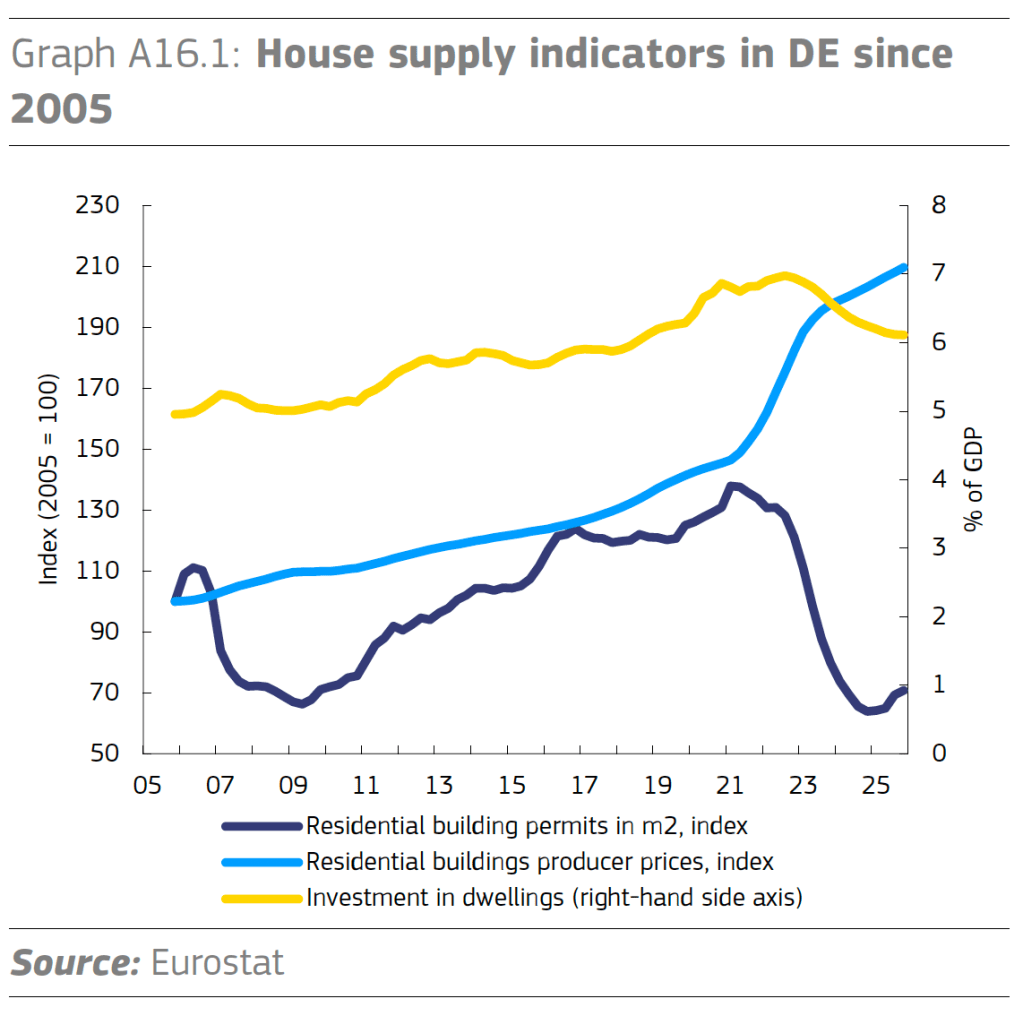
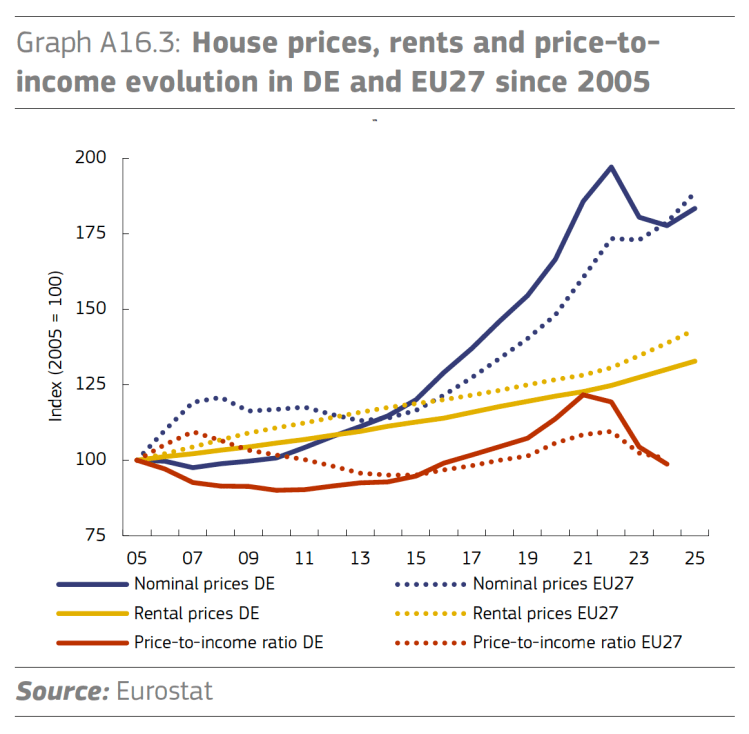
Seit 2005 sind die Hauspreise und Mieten für neue Verträge nach der EU-Kommission deutlich stärker gestiegen als die Inflation und das Einkommen. Allerdings seien die durchschnittlichen Mieten weniger als die Inflation und das Einkommen gestiegen. Infolgedessen werden die persönliche und arbeitsbezogene Mobilität behindert, was das Wirtschaftswachstum belastet.
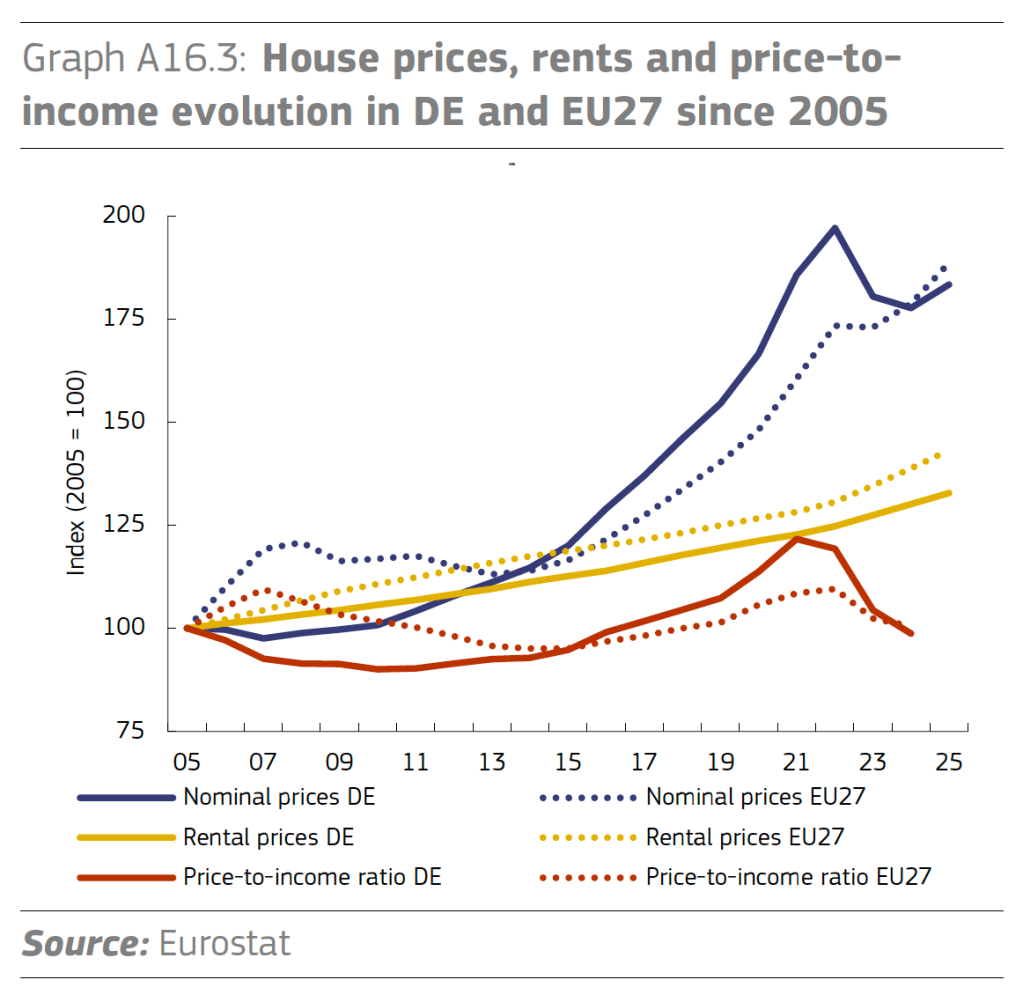
In addition, the resulting gap between existing and new rental prices leads to a ‘lock-in effect’, creating a disincentive for people with existing contracts to move out, reducing housing and ultimately labour mobility.
Siehe auch:
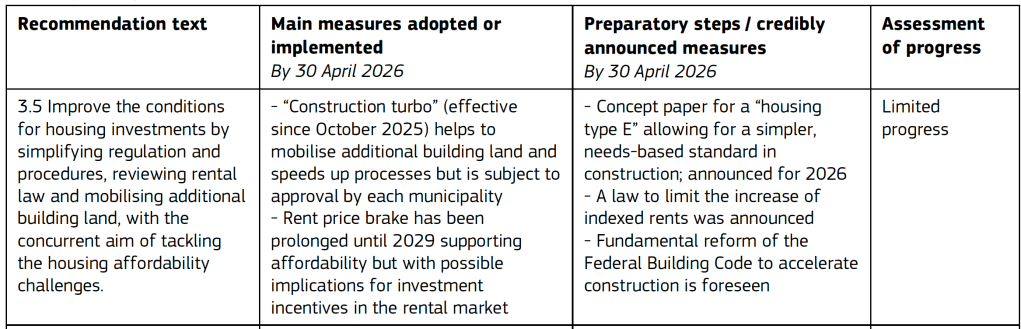
Die zugrunde liegenden Gründe sind nach der EU-Kommission unter anderem politische Maßnahmen, die Investitionen in Mietwohnungen weniger attraktiv machen, beispielsweise durch die Begrenzung von Mieten und Mieterhöhungen. Angesichts des hohen Anteils an Mietern und des Bedarfs an privatem Kapital zur Deckung der Wohnungsnot ist daher die Attraktivität des Sektors für private Investitionen entscheidend. Sehr deutlich wird die deutsche Mietpreisregulierung kritisiert:
Rent control does not address the underlying causes of housing affordability challenges. … At the same time, rent control comes with adverse effects, such as reduced mobility of tenants, and may further increase rents in the unregulated new-build segment. The rental law has therefore not been made more investment friendly, as recommended by the country-specific recommendation. … If rent control is too restrictive, it can weaken private investment incentives in the housing sector and hinder the efficient use of available housing.
Die Kommission schätzt den zusätzlichen Wohnungsinvestitionsbedarf für 2025-2035 auf etwa 80.000 Wohnungen jährlich, wobei zwei Drittel in Metropolregionen liegen. Der Bedarf an neuem Wohnraum ist demnach in Deutschland sehr ungleich verteilt und konzentriert sich auf Gebiete wie urbane Zentren mit wachsender Bevölkerung.
Die zum Wohnungbau erforderliche Bauwirtschaft aber droht an ihren eigenen Defiziten zu scheitern.
However, three out of four manufacturers and a large share of companies in the building sector consider the acute lack of skilled workers to be the central issue slowing down projects, driving up costs and limiting the urgently needed expansion of housing and infrastructure. At the same time, the sector struggles with precarious working conditions that make recruitment a challenge. Physically demanding labour, combined with comparatively unattractive wages and frequent use of subcontracting chains, creates risks of exploitation, wage dumping or violations of minimum standards, affecting migrant workers in particular.
Schließlich sieht die EU-Kommission noch Raum für Verbesserungen bei der Besteuerung und Regulierung von Wohnimmobiliengeschäften. Anreize zur Nutzung verfügbaren Baulands könnten verbessert werden, indem die Besteuerung von Transaktionen auf wiederkehrende Besteuerung umgestellt wird. Die Kosten für Wohnimmobilientransaktionen, einschließlich Notar- und Registrierungsgebühren, Erwerbssteuer und möglicherweise Maklergebühren, sind im internationalen Vergleich hoch, so der Report.
© Copyright by Dr. Elmar Bickert
Rent control does not address the underlying causes of housing affordability challenges. …
At the same time, rent control comes with adverse effects, such as reduced mobility of tenants, and may further increase rents in the unregulated new-build segment. The rental law has therefore not been made more investment friendly, as recommended by the country-specific recommendation. …
If rent control is too restrictive, it can weaken private investment incentives in the housing sector and hinder the efficient use of available housing.
European Commission – 2026 Country Report – Germany (3.6.2026 – SWD(2026) 205 final)


Du muss angemeldet sein, um einen Kommentar zu veröffentlichen.